GOOD MATERIALS. SMALL STEPS. SOMETHING YOURS.
Made in Steps
HomeBeginner sewing
Subject guide

Beginner sewing

Build confidence with a readable pattern, suitable fabric and a practice seam. Keep cut size, seam lines and material direction distinct.

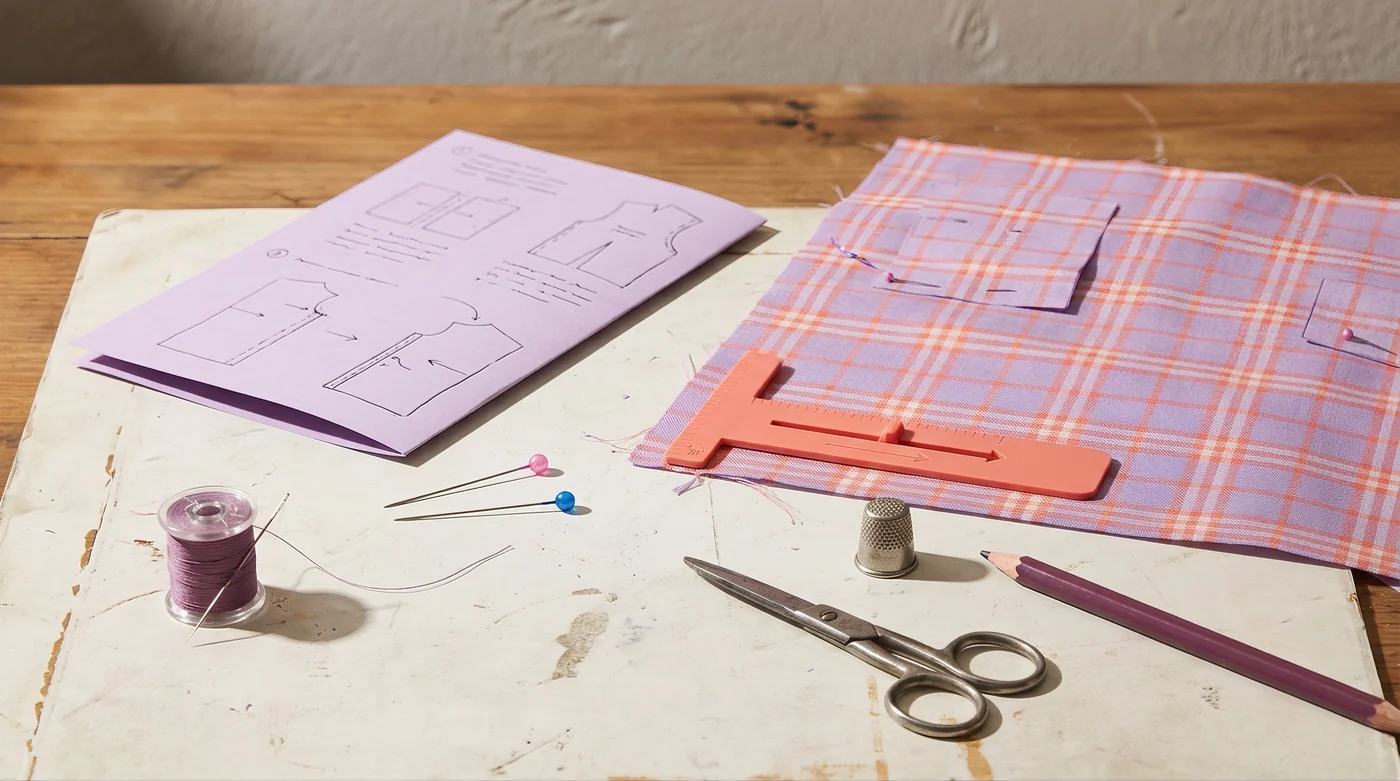
Folded fabric, pins, thread and a sewing plan on the craft table.
AI-generated editorial illustration · not a tested sewing sample

Choose a pattern with a visible construction

Start with an object whose pieces and seams you can describe on one page. Record whether the pattern expects woven or knit fabric, how many layers each seam joins and how the object is finished. A simple shape is easier to inspect when the fabric suits the pattern. Keep an appealing fabric print as a design choice, separate from whether that fabric belongs in the construction.

Find out whether the seam allowance is included

The cut edge and the stitched line are different boundaries. Read the pattern’s allowance statement before changing a piece. Adding an allowance to a pattern that already includes one changes the dimensions; forgetting a required allowance makes the intended stitched area smaller. Mark the grainline, fold line and any notches independently. Our rectangular sheet planner cannot replace a pattern layout that has directional or matching requirements.

Treat needle, thread and fabric as a combination

Record the needle system your machine requires, then select the type and size for the actual fabric and thread. SINGER’s guide distinguishes needle points and sizes for different material constructions. The appropriate choice still belongs to your machine’s instructions. Use offcuts representing the same layers as the project, and follow the machine manual when fitting or changing a needle.

SINGER: choosing machine needles ↗ — Needle type and size depend on the fabric and thread; confirm the system required by your own machine.

Keep the practice seam with the pattern

Make the trial large enough to see the stitching and how the layers lie after the pattern’s specified finishing steps. Inspect both faces, the seam position and any gathering or puckering. Record the settings you actually used, without claiming one sample establishes strength or long-term wear. If several variables change, keep separate samples; otherwise the new needle, different thread and revised setting become impossible to distinguish.

Keep these details together.

  • Pattern dimensions and seam allowance
  • Fabric width and direction
  • Needle, thread and practice sample

Go a little deeper.

Craft Materials & Techniques Library ↗
Beginner sewing: Choose a pattern with a visible construction; Find out whether the seam allowance is included; Treat needle, thread and fabric as a combination
READ THE DETAILS

Keep going with beginner sewing

Questions to start with

What is a 1/2 inch seam allowance?

It is the distance between the stitching line and the cut edge: half an inch equals 12.7 mm. Whether you need to add that allowance depends on the pattern. For a simple rectangle that finishes 100 mm wide with 12.7 mm on both sides, the cut width is 125.4 mm. Curves and construction details need their own pattern instructions.

SINGER: pattern cutting and seam allowances ↗

All guides · All questions

Equipment to consider

Choose for the way you use it.

As an Amazon Associate I earn from qualifying purchases. These are researched product options, not hands-on test results. Check the exact model, current price and availability on Amazon.

Model matched · suitability first

Brother CS7000X

A sewing-machine candidate for general sewing and quilting projects. Check included feet, regional voltage and the fabrics you plan to use.

View on Amazon ↗
Model matched · suitability first

OLFA RTY-2/DX 45 mm rotary cutter

A rotary cutter for fabric cutting on a suitable mat. Keep the blade guarded between cuts and choose a grip that feels secure.

View on Amazon ↗

Compare before you choose

Match the task and setup before considering price. These notes are editorial research, not performance scores.

Product optionFit and limits to check
Brother CS7000XA sewing-machine candidate for general sewing and quilting projects. Check included feet, regional voltage and the fabrics you plan to use.
OLFA RTY-2/DX 45 mm rotary cutterA rotary cutter for fabric cutting on a suitable mat. Keep the blade guarded between cuts and choose a grip that feels secure.
Made in Steps

Your privacy choices

With your permission, we use Google Analytics to understand which pages people read. We do not load Google Analytics without your consent. The calculators work with either choice.

Advertising and personalisation stay off. Your choice applies only to this site. Change it anytime using “Cookie settings” in the footer.

Privacy and storage details